

The Utility of Intensive Treatments in Improving SMQ Scores
in School-Aged Children with Selective Mutisms
Avery Colvin
Eastern Michigan University | Behavioral/Clinical Program
March 20th, 2026
Below is an abbreviated review of Avery’s full capstone project.
There are a variety of treatment options available for children with selective mutism. The main two categories of treatment are medication-based intervention and nonmedication interventions. Medication-based treatment can consist of selective-serotonin reuptake inhibitors (SSRIs) that can help lower anxiety symptoms and increase inhibition. Nonmedication interventions are based more on psychotherapeutic approaches like behavioral therapy, psychodynamics, and family therapy (Wong, 2010). Both medication and therapeutic interventions are effective in reducing the severity of anxiety symptoms, but the most effective form of treatment is when they are used together (Compton et al., 2010). Specifically, Behavioral and Cognitive-Behavioral therapy (CBT), have the strongest scientific support of the psychotherapeutic approaches (Selective Mutism Association, 2026). In a meta-analysis conducted by Steains et al. (2010), it revealed that a behavioral-systems approach was the most common treatment type. This approach combines psychoeducation and behavioral techniques for parents and teachers.
While there are a mix of different techniques used in CBT, stimulus fading and shaping are used to help increase speech and decrease anxiety symptoms.
Stimulus fading helps gradually increase speech with new people and environments. In the context of SM treatment this might look like having the child in a room with a preferred speaking partner, then after comfortable speech has been maintained, an unfamiliar person will gradually join in. This process looks like the unfamiliar person not engaging with the child but staying inside the room then slowly moving closer to the child while they are maintaining speech with their preferred speaking partner. In the final stages, the unfamiliar person can join in conversation with the child speaking comfortably in front of all parties. Stimulus fading is “Gradually transitioning a comfortable context into a feared” context (Zakszeski & DuPaul, 2016, p.3). Shaping refers to using reinforcement of successive approximations of speech to increase speech complexity (Selective Mutism Association, 2026). In the context of SM, Shaping is broken down into many steps. This can look like reinforcing non-verbal gestures, then reinforcing single word responses, then two-word responses, and so on. These steps can be broken down even smaller with voiceless sounds to voiced sounds. Reinforcement is provided by verbal praise or a physical reward, such as a toy or preferred item. Once a child can complete a step successfully then we move to the next step and increase the speaking demand.
Treatment can look very different on a case-by-case basis. Many individuals diagnosed with SM tend to struggle in areas where others might flourish, for example, some people might be very consistent in speaking with same age peers but not with adults. Others might have difficulty speaking with extended family or unfamiliar community members.
A newer treatment model for SM uses the same techniques found in regular treatment but in an intensive format. Intensives involve providing several hours of therapy per day over consecutive days. The structure includes 15-25 hours over 3-5 consecutive days.
This is designed to create momentum in meeting treatment goals by increasing progress rapidly. This model allows for flexibility in treatment while having access to real-world settings, boosting confidence, and continuously gaining skills at a faster rate than traditional 1-hour weekly sessions (Thriving Minds behavioral health, 2026). Intensive treatments work to mimic the settings or situations that a child with SM has the most difficult speaking in (Georgiadis et al., 2024). It also provides more opportunities for parents and teachers to increase eliciting verbal behavior (Cornacchio, et al., 2019). Intensive treatments also use the behavioral techniques stimulus fading (fade in) and shaping. These intensives target specific areas the child may struggle in by encouraging the mastery of a previous skill that assist in the child’s proficiency in more challenging goals. Intensives also offer parent skills training to help provide psychoeducation, modeling for effective communication, and school consultations to support all aspects of the child’s day-to-day life.
Methods
Participants were evaluated using The Selective Mutism Questionnaire (SMQ) (Bergman et al. 2008) to see if scores had increased before-and-after completing an intensive treatment. A typical Intensive follows this structure: Day 1 features a direct observation; psychoeducation of anxiety, SM and review of assessments; then a fade in with the treating clinician, and goal setting with family. Day 2 includes a 15-minute warm up time; review of anxiety psychoeducation and monitoring symptoms; then a fade in with another clinician; after verbal games in clinic and a prep session for a community exposure, a community exposure is completed; and finally a parent discussion about goals and problem solving ends the day. Day 3 begins with a 10-mintute warm up time; then three different community exposures that are specialized for different speaking demands follow; the day ends with a parent discussion of goals and problem solving. Day 4 includes the shortest warm up time of 5-mintutes; then following five community exposures to help target specific speaking goals, there is wrap up with parents about future goals, problem solving and a school consultation.
The SMQ is a parent rating scale for children 3-11 years old that helps measure the intensity of SM rated speaking behavior. The questionnaire has 17 items, with a three-factor structure of speaking in the context of School (6 items), Home/Family (6 items), and Community (5 items). Questions are scored on a 4-point Likert scale ranging from 0 (never speaking) to 3 (always speaking), with a total SMQ score ranging from 0 to 51 (Pereira et al., 2021). School and Home/family have a total of 18 points available, and Community has a total of 15 points available. Subscales are scored by adding all points together then dividing by the number of items in the subscales. The total SMQ score is calculated by adding all points from the 17 questions together. A lower number on a subscale indicates a higher severity of symptoms, and a higher SMQ total score represents a lower severity of symptoms. Parents/caregivers provided these scores before intensive treatment, then again at 3-months post treatment to explore the utility of intensive treatments addressing SM symptoms as measured by SMQ scores.
Participant data and intensives were completed with Katelyn Reed, M.S. LLP between 2020-2025. Originally there were 21 total participants. Selection criteria required that all participants had to meet the diagnosis criteria of selective mutism, be between the ages of 3 and 11 to account for the validity of the SMQ, did not have a birthday between intensive completion and 3-month post intensive, had completed all questions on the SMQ pre- and post-questionnaires and lastly, were not completed during the new year period (2025-2026). After the selection criteria were applied, a total of 10 participants were left, four boys, and six girls. Girls' ages included one 3-year-old, two 5-year-olds, and one 7- and 8-year-old. Boys’ ages included two 5-year-olds and two 7-year-olds. Microsoft Excel was used to produce graphs of each participant’s pre- and post-questionnaires.
Discussion
Collectively, all participants showed improvements in their total SMQ score. They also all showed improved scores on the school subscale. Six participants had this subscale as their largest improvement from pre-to-post intensive compared to the other subscales. Six participants showed improvement in their Family/Home subscale score. Three participants had their scores stay the same from Pre and Post intensive. Two had this category as their largest increase in scores from pre-to-post intensive compared to the other subscales. Community had eight participants show improved scores with the score staying the same for one participant and one decreasing from pre-to-post evaluation.
When separated by gender, girls had a slightly higher mean score across subscales on pre-intensive scores. Boys had a higher School mean score in the post-intensive scores. Girls also had a slightly higher SMQ total for both pre-and-post-scores. This is detailed in Table 1 below. Girls showed more improvement in severity of symptoms compared to boys. This could be due to the partially higher prevalence rate among girls and small sample size for this study.
Table 1. Mean SMQ Scores Before and After Intensive Treatment by Gender
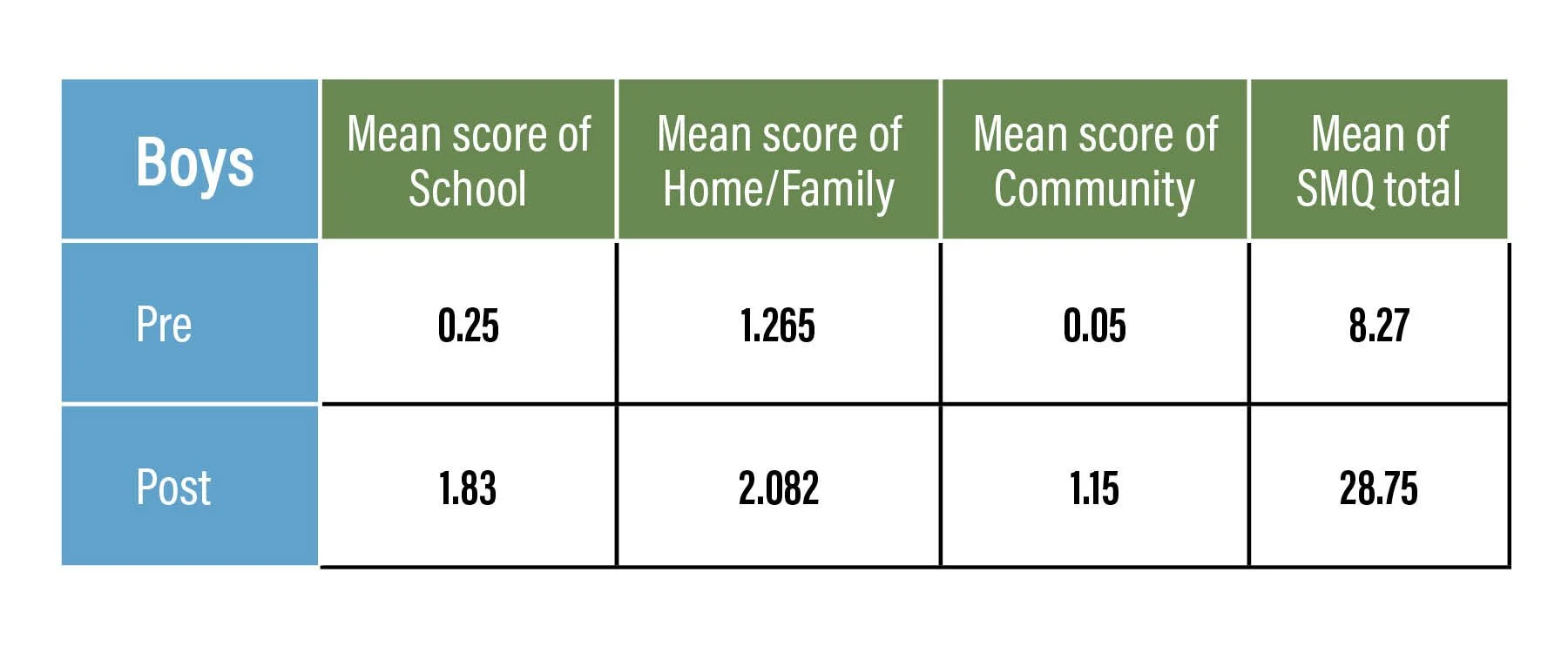
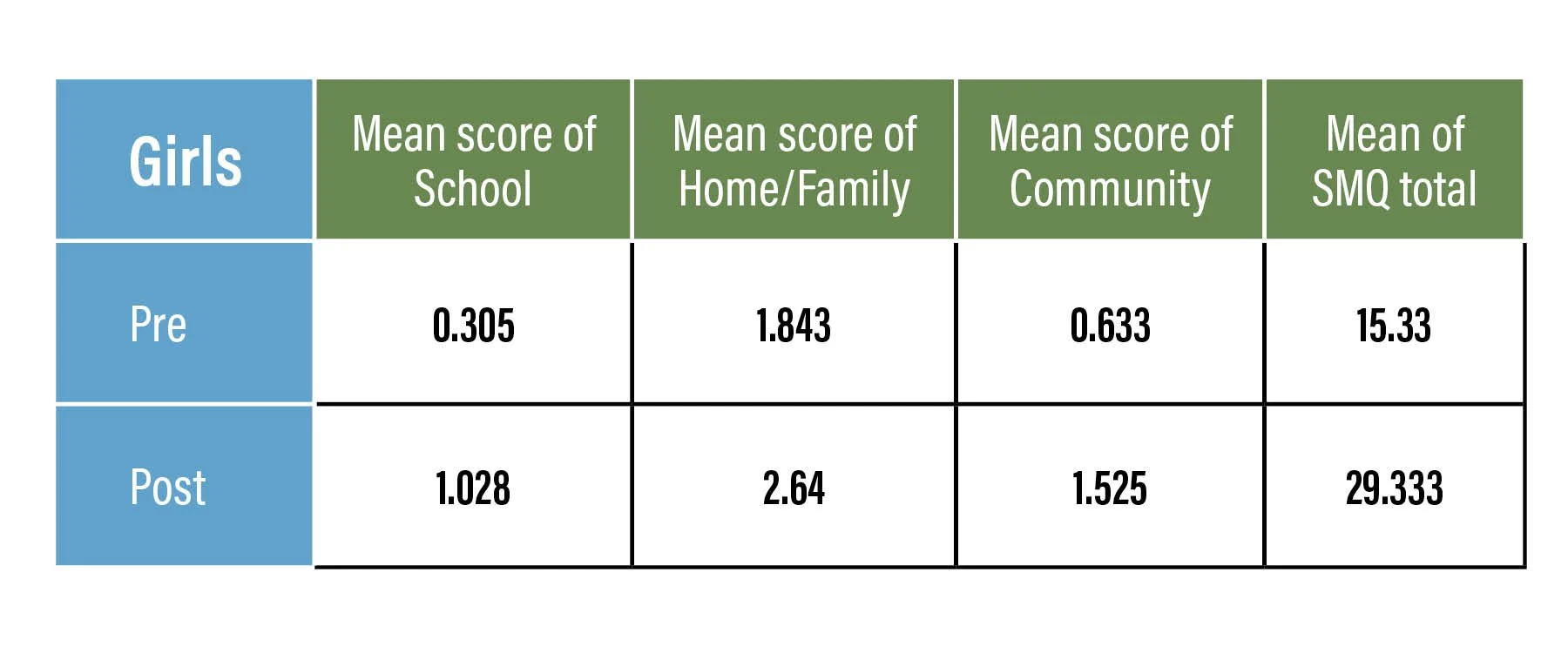
Note: The total number of participants was 10. Six participants were girls and four were boys. Scores represent mean values from the Selective Mutism Questionnaire (SMQ) collected before (pre) and after (post) intensive treatment.
Intensive models of treatment for selective mutism can be very effective in decreasing anxiety symptoms shown by evaluating Pre-and-Post SMQ scores. The flexible modality offers a unique way to target specific goals for each client and can help make progress toward improving SM symptoms. This model uses important techniques like stimulus fading and shaping to adapt to the child's current skill level. Using a fade-in, the clinician can slowly introduce unfamiliar people and places to reduce anxiety symptoms, allowing the child to establish speech in those situations. Using shaping techniques allows clinicians to start at the level a child is consistently speaking at and use that success to move forward towards a more difficult step. These techniques can be a key aspect in building confidence, eliciting speech, and meeting treatment goals more quickly than in traditional 1-hour sessions per week.
All participants showed improved scores on the school subscale despite only one participant being explicitly trained in that environment. Family/Home showed generalization of skills even without any training within that environment. This could be influenced by parent training and direct modeling for effective communication provided by the Intensive treatment. In future research, a larger sample size would help to explore a greater generalizability of findings in treatment models for selective mutism. The Frankfurt Scale for the Assessment of Selective Mutism (FSSM) and Screen for Child Anxiety Related Disorders (SCARED) could also be additional measures used to evaluate anxiety and SM symptoms. Overall, Intensive treatments provide a flexible treatment model that is designed for each child's strengths and weaknesses, while offering parents an opportunity to better support their child’s growth.
Note: The total number of participants was 10. Selective Mutism Questionnaire scores for Pre-intensive (Pre) and Post-intensive (Post) in subcategories of school, Home/Family, and Community.
Note: The total number of participants was 10. Selective Mutism Questionnaire total scores for Pre-intensive (Pre) and Post-intensive (Post).
References
American Psychiatric Association. (2022). Diagnostic and statistical manual of mental disorders (5th ed., text rev.; DSM-5-TR). https://doi.org/10.1176/appi.books.9780890425787
Bergman, R. L., Keller, M. L., Piacentini, J., & Bergman, A. J. (2008). The development and Psychometric properties of the Selective Mutism Questionnaire. Journal of Clinical Child & Adolescent Psychology, 37(2), 456–464. https://doi.org/10.1080/15374410801955805
Compton, S. N., Walkup, J. T., Albano, A. M., Piacentini, J. C., Birmaher, B., Sherrill, J. T., Ginsburg, G. S., Rynn, M. A., McCracken, J. T., Waslick, B. D., Iyengar, S., Kendall, P. C., & March, J. S. (2010). Child/Adolescent Anxiety Multimodal Study (CAMS): rationale, design, and methods. Child and Adolescent Psychiatry and Mental Health, 4(1), 1. https://doi.org/10.1186/1753-2000-4-1
Cornacchio, D., Furr, J. M., Sanchez, A. L., Hong, N., Feinberg, L. K., Tenenbaum, R., Del Busto, C., Bry, L. J., Poznanski, B., Miguel, E., Ollendick, T. H., Kurtz, S. M. S., & Comer, J. S. (2019). Intensive group behavioral treatment (IGBT) for children with selective mutism: A preliminary randomized clinical trial. Journal of Consulting and Clinical Psychology, 87(8), 720–733. https://doi.org/10.1037/ccp0000422
Driessen, J., Blom, J. D., Muris, P., Blashfield, R. K., & Molendijk, M. L. (2019). Anxiety in Children with Selective Mutism: A Meta-analysis. Child Psychiatry & Human Development, 51(2), 330–341. https://doi.org/10.1007/s10578-019-00933-1
Georgiadis, C., Furr, J. M., & Comer, J. S. (2024). Intensive treatment of childhood selective mutism. In CBT: science into practice (pp. 91–112). https://doi.org/10.1007/978-3-031-60746-2_6
Pereira, C. R., Ensink, J. B. M., Güldner, M. G., Lindauer, R. J. L., De Jonge, M. V., & Utens, E. M. W. J. (2021). Diagnosing selective mutism: a critical review of measures for clinical practice and research. European Child & Adolescent Psychiatry, 32(10), 1821–1839. https://doi.org/10.1007/s00787-021-01907-2
Selective Mutism Association. (2021, August 6). Treating selective mutism. https://www.selectivemutism.org/treating-selective-mutism/
Selective Mutism Treatment and Therapy — Thriving Minds. (n.d.). Thriving Minds. https://www.thrivingmindsbehavioralhealth.com/selective-mutism-treatment
Steains, S. Y., Malouff, J. M., & Schutte, N. S. (2021). Efficacy of psychological interventions for selective mutism in children: A meta‐analysis of randomized controlled trials. Child Care Health and Development, 47(6), 771–781. https://doi.org/10.1111/cch.12895
NHS. (2025, November 12). Selective mutism. https://www.nhs.uk/mental-health/conditions/selective-mutism/
Wong, P. (2010, March 1). Selective Mutism: A review of etiology, comorbidities, and treatment. https://pmc.ncbi.nlm.nih.gov/articles/PMC2861522/
Zakszeski, B. N., & DuPaul, G. J. (2016). Reinforce, shape, expose, and fade: a review of treatments for selective mutism (2005–2015). School Mental Health, 9(1), 1–15. https://doi.org/10.1007/s12310-016-9198-8